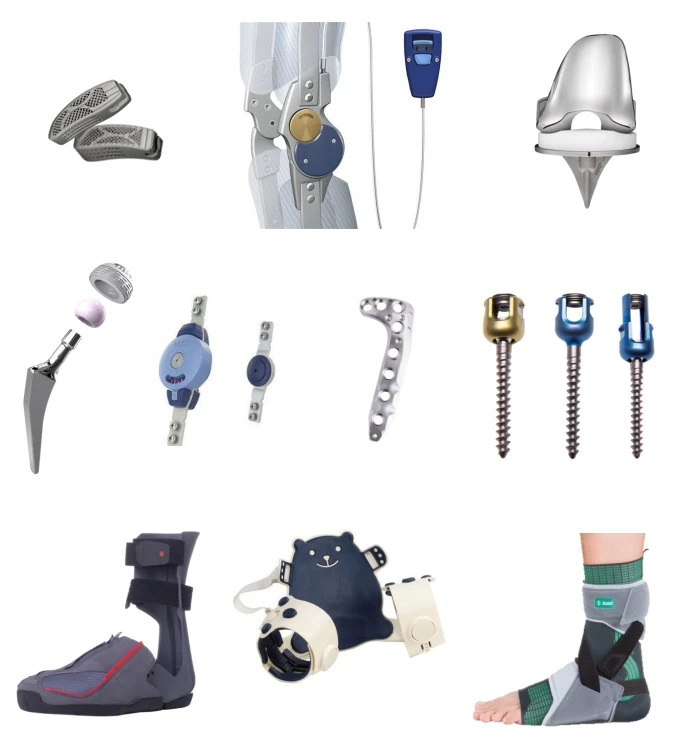
Harnessing Orthosis Development, Innovation, and Product Improvement
It is often said that an orthosis is “fully developed,” with no significant innovations remaining. Many improvements are seen as minor, such as adding new sizes, colors, or materials. But is this really the case? How can you tell when a product has reached full maturity, and when innovation is needed?
Using the TRIZ S-Curve to Track Product Evolution
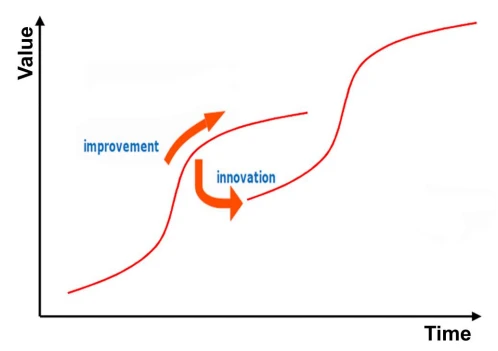
The TRIZ S-Curve is a useful tool for visualizing the evolution of medical devices. Each S-Curve represents three phases of development: development, introduction, and maturity. When product improvements no longer deliver sufficient value, the S-Curve highlights the need for innovation. The transition from improvement to innovation requires courage, as initial versions of new devices may perform worse than established models.
Example: Ankle-Foot Orthoses
Ankle-foot orthoses (AFOs) illustrate this concept well. First-generation AFOs were mechanical and provided static support. The ankle stiffness was fixed before an activity, such as walking, and varied only in dorsiflexion or plantarflexion.
Second-generation AFOs, however, introduced dynamic support. Stiffness can now adjust during activity, improving function and patient comfort. A notable example is the unpowered exoskeleton, which uses a clutch to vary support while walking.
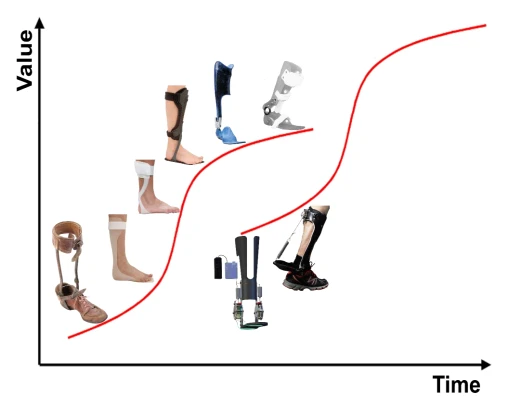
The evolution of AFOs shows multiple S-Curves:
-
First-generation AFOs: Heavy leather and steel braces (C1200) were gradually replaced by lighter plastic versions, such as Posterior Leaf Spring (PLS) and Foot Drop Braces. Variations in trim lines improved stiffness or flexibility.
-
Second-generation AFOs: New materials like carbon enabled lightweight devices with energy return, such as Ground Reaction Force orthoses. A deeper understanding of patient-specific ankle stiffness led to innovations like Neuro Swing and AFOs with oil dampers. Dynamic AFOs, such as the Adjust brace
Timing Innovation for Maximum Impact
Knowing when to innovate is not an exact science. Transitioning too early may be unprofitable, while waiting too long can allow competitors to gain advantage. Evaluating the phase of your device development, improvement, or maturity helps guide decisions.
A clear viewpoint allows you to focus on:
-
Cost reduction for efficiency
-
Function improvement for patient benefits
-
Disruptive innovation for market differentiation
Real-World Examples
At BAAT Medical, we have applied these principles to both improved and innovated orthoses, showing how careful timing and targeted innovation can lead to meaningful advances in medical devices.