3D-Printed Instruments in Orthopedic Surgery: Expert Insights from Matthijs van Dam
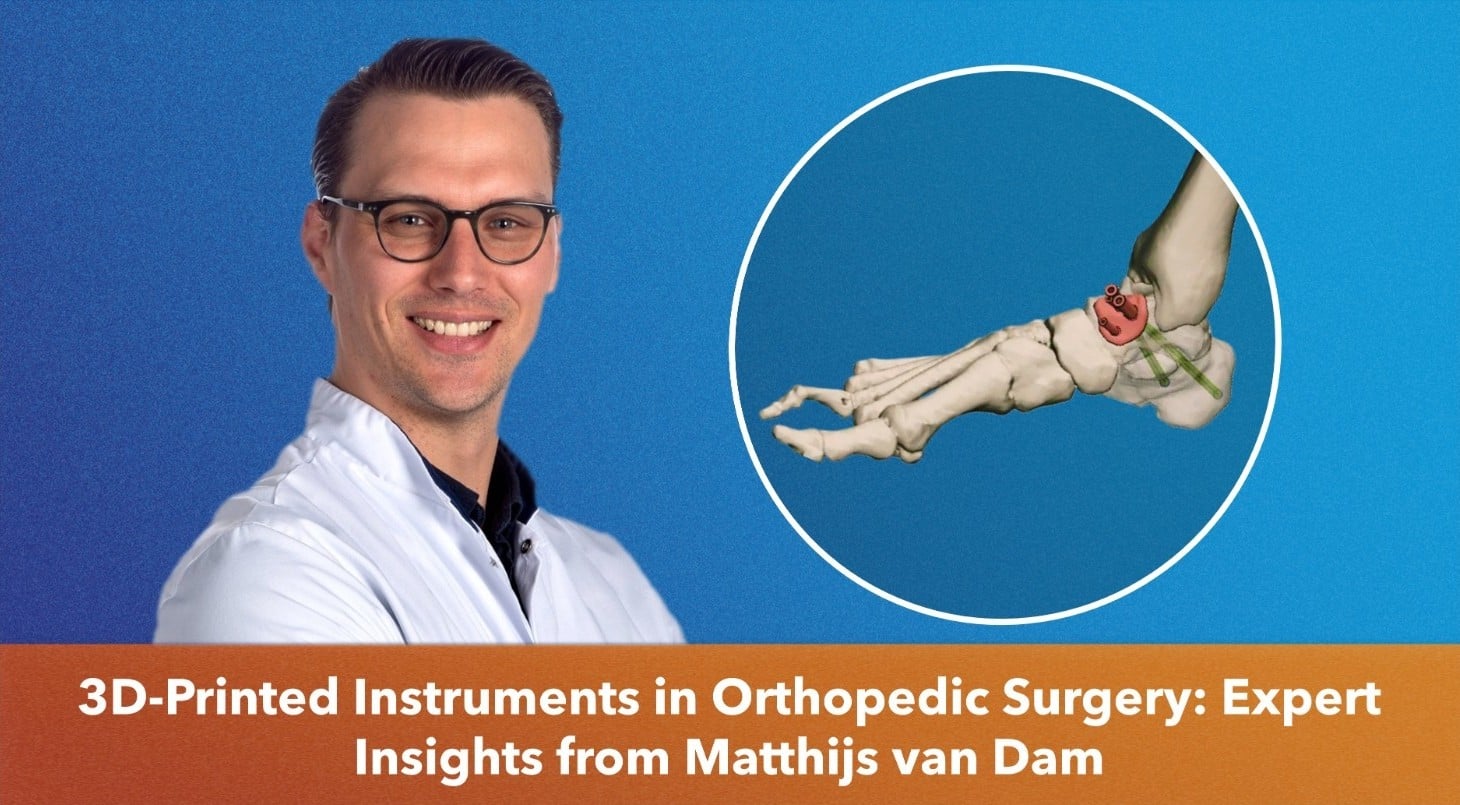
At the iconic Hotel de Wereld in Wageningen, Erik van de Garde, CEO of 3D Medical Models, spoke with Matthijs van Dam, an orthopedic surgeon at ETZ in Tilburg. Van Dam specializes in foot and ankle surgery. He is researching how 3D-printed patient-specific instruments (PSI) can make complex surgeries more precise and predictable.
PSI is already widely used internationally in knee osteotomies, spinal surgery, ankle prostheses, and forearm corrections. Van Dam focuses on expanding this technology within foot and ankle surgery.
He views 3D technology and PSI as a tool, not a goal. When used correctly, it adds real value. From a scientific perspective, he helps guide research and implementation in the coming years.
The benefits of 3D technology in orthopedics
In his daily practice, he primarily uses 3D-printed surgical guides for more complex procedures, such as revision surgeries in foot and ankle surgery.
“With a 3D guide, I can place screws according to a pre-planned trajectory. This can sometimes be necessary when screws have broken off in a bone or when there are large bone defects where a screw has little grip,” he explains.
For Van Dam, PSI is emphatically not a goal in itself, but a tool that, if properly researched, can contribute to better and reproducible care. This can lead to:
- Increased precision: the technology reduces guesswork, which is crucial for revisions after failed fusion surgeries.
- Faster procedures: Accurate preparation can potentially shorten the operating time, thus reducing the risk of complications.
- Increased predictability and confidence: 3D technology supports surgical planning. “You have a better understanding of what to expect,” says Van Dam.
Challenges in the healthcare sector.
Despite the advantages, the adoption of 3D technology in orthopedics is not always rapid. Van Dam points to daily practice: “Hospitals are busy, so preparation for 3D applications often still takes place in the evenings at the kitchen table.”
Reimbursement also remains a bottleneck. While an additional (and not always proven beneficial) screw or expensive plate is usually reimbursed, the cost of 3D-printed instruments is often not covered, even though they have the potential to improve outcomes and reduce healthcare costs.
Education, Access, and the Future of 3D Technology
According to Van Dam, 3D technology can help make complex procedures less dependent on a small number of super-specialists. With good preoperative planning and patient-specific guides, certain operations can be performed in a more standardized manner, even in hospitals with less experience in these cases. This makes high-quality, complex care accessible to more patients and in more locations. He also sees clear added value in 3D visualizations in his training: they make anatomy and surgical steps more concrete, support operating room preparation, and can thus accelerate the learning curve of orthopedic surgeons in training (residents) and young orthopedists. Until recently, he taught orthopedic residents as a “root-trick” using a pair of carrots as improvised teaching aids. These were ideal for drawing joints, osteotomies, and screw paths, but still slightly less precise than a good 3D model.
He is convinced that 3D technology will be a permanent fixture in orthopedics. He hopes that health insurers and hospitals will better recognize the benefits and adjust reimbursements and time investment accordingly. If the use of 3D planning and patient-specific, compliant printed instruments is structurally facilitated, economies of scale can be better utilized, and healthcare can be organized both more efficiently and predictably.
Conclusion
BAAT Medical and 3D Medical Models work closely with clinical partners like Matthijs van Dam. Together, we explore how compliant 3D-printed instruments can contribute to improved healthcare outcomes, increased surgeon confidence, and made complex surgery more accessible.
Curious how our compliant 3D-printed solutions can help your hospital and optimize your workflow? Schedule a consultation or read our whitepaper on compliant 3D technology in orthopedics.