FDA 510(k) Pathway and Opportunities Introduction
The US is becoming a priority market for medical device development more than ever before. Many new medical projects now prioritize submission through the American Food and Drug Administration (FDA) instead of going straight to the EU market. This shift happens for several reasons. The US offers a larger market compared to the EU, which increases business potential. In addition, reimbursement policies and the overall regulatory efficiency of the FDA make the process attractive.
FDA Regulations for Orthopedic Implants | FDA example
The FDA uses a risk-based approach to regulate medical devices, including orthopedic implants. This process ensures safety and effectiveness while encouraging innovation. Market approval requires strict design control, change control procedures, and compliance with FDA regulations (21 CFR 820). BAAT Medical supports manufacturers by defining the regulatory pathway and identifying the correct device classification.
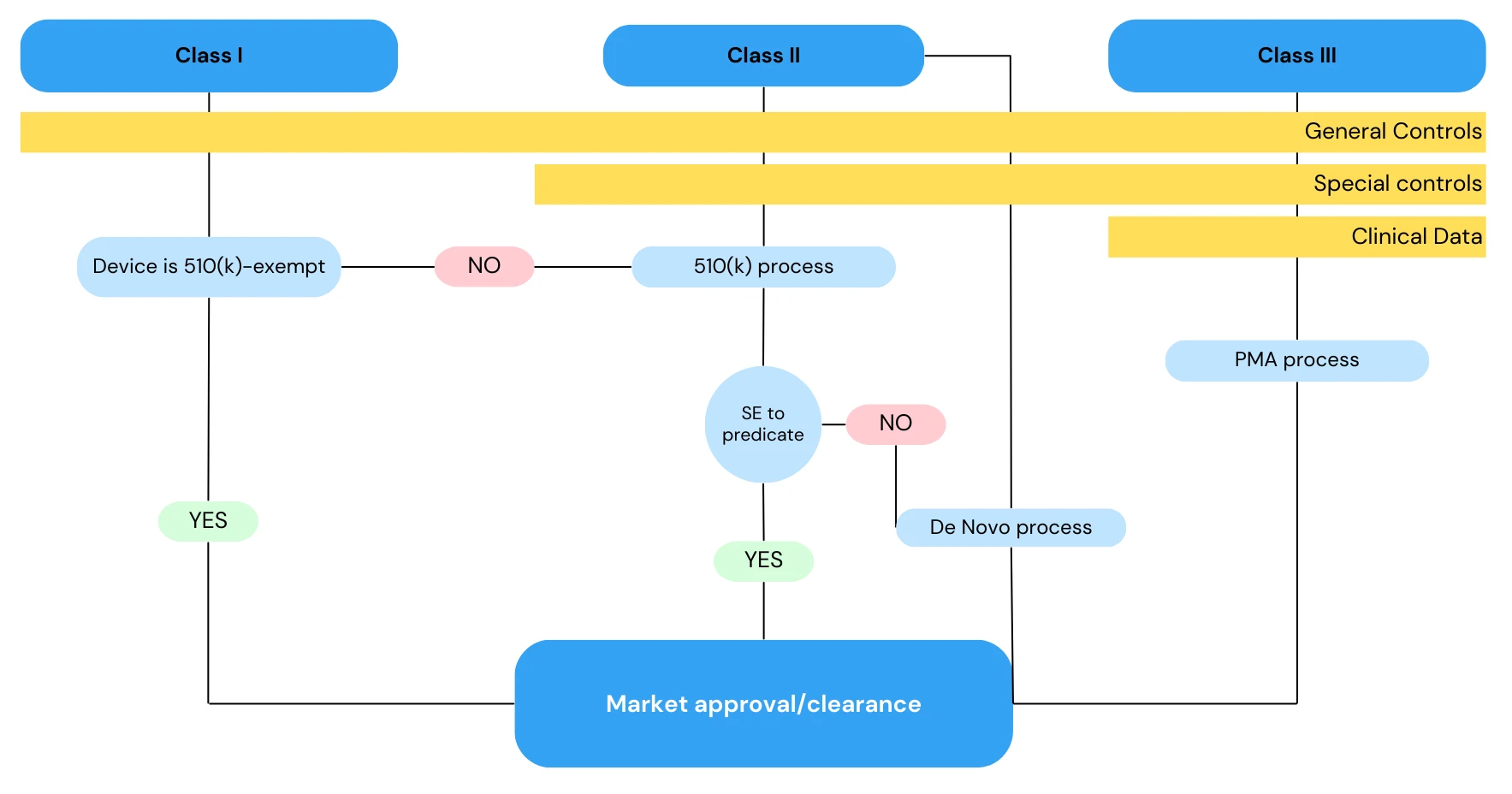
Device Classes Explained
Class I
Class I devices are exempt from the 510(k) process. Only general controls apply to evaluate their safety and effectiveness.
Class II
Class II devices must go through the 510(k) process. Manufacturers need to prove substantial equivalency (SE) to a predicate device already marketed in the US.
Class II – De Novo
If equivalency cannot be demonstrated, the device enters the De Novo process. The FDA then creates a new device type, classification, regulation, and product code.
Class III
Class III devices usually require Pre-Market Approval (PMA). Applicants must provide clinical data to prove safety and effectiveness.
And how to de-risk your decision?
Here is where the FDA’s regulatory efficiency comes into play, as the agency offers a number of opportunities before (and during) the marketing application for medical devices, including orthopedic implants. For example, the FDA has in place (and recommends) Q-Submission programs that can be initiated to gather feedback on a (future) marketing application. These programs provide interaction with the FDA review team, both in a written and non-written form (e.g., videoconferences). Feedback is provided in a reasonable timeframe: the review time of a Q-Submission is usually 70 calendar days.
Nevertheless, there are ways to speed up the process, provided that certain conditions are met. In fact, the FDA has arranged a number of Special Programs – Breakthrough Device Program, and Safer Technologies Program, to name a few. These programs are aimed at expediting development and acceptance of certain medical devices. They are mainly reserved to products that address debilitating conditions/illnesses, and/or provide a safer or more efficient way of diagnosing medical problems.
Eligible Medical Devices 510k, De Novo, PMA submissions
Medical devices are eligible for such programs only if they meet specific conditions, and if they are subject to premarket approval applications (PMA), premarket notification [510k)], or requests for De Novo classification request.
In these cases, the FDA would prioritize submissions related to medical devices that are granted this kind of “status”. The interaction is quicker, prompt feedback is provided on the development process, all to ensure that a medical device that answers important clinical needs would be available on the market in the least amount of time.
BAAT Medical has built up extensive experience over the years through its consultancy on the dynamic of the FDA processes and programs, with particular focus on orthopedic implants. We strive to de-risk the regulatory pathway for our customers’ medical devices, to make sure that we are always conscious of the effort needed to their safety and performance, and to smoothen the US marketing approval.