Design and verification of a concept
Situation
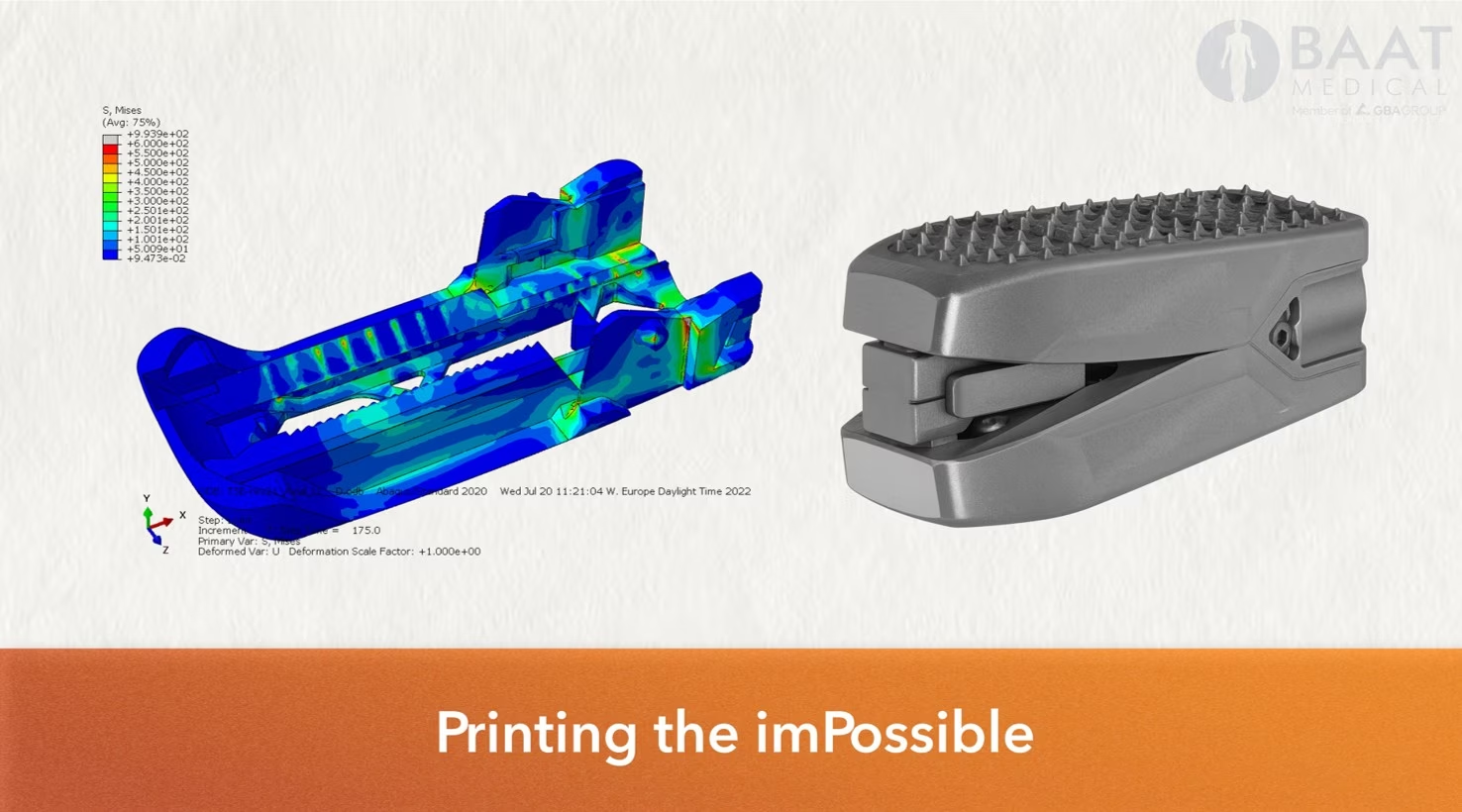
A European startup set out to develop a fully 3D-printed spinal cage with an expandable design. The concept offered significant potential for innovation. However, the device also presented a major engineering challenge. The cage needed to remain mechanically stable under the dynamic loads experienced by the lumbar spine. Therefore, the design required careful development and extensive verification. The team needed to prove that the concept could withstand the forces expected during clinical use. At the same time, the design had to make full use of the possibilities offered by additive manufacturing.
Capabilities
Developing the 3D-printed spinal cage required specialist knowledge of additive manufacturing. The design had to take advantage of the freedom offered by 3D printing. This approach made it possible to create complex mechanisms in a single production run. Such geometries would have been difficult or impossible to manufacture using conventional production methods.
In addition, the project required expertise in the mechanical behavior of 3D-printed titanium structures. This was particularly important under dynamic loading conditions. Finite Element Method (FEM) modeling also played an important role. The modeling helped assess mechanical performance and accelerate the design and verification process.
Solution
BAAT provided a complete development service through an internal team with the required expertise. First, BAAT established a collaboration with a specialized FEM modeling partner. BAAT then coordinated the verification activities and supported the development process from design through testing. Because a fully 3D-printed expandable spinal cage had not previously been achieved, the project required an iterative approach. The team continuously reviewed the results and used them to guide design improvements. This process involved close communication between the different specialists. BAAT advised on design changes and implemented improvements based on the verification results. The team also had to balance mechanical performance with market requirements. As a result, each design iteration considered both technical feasibility and the intended application.
Result
Through this iterative development approach, BAAT successfully established a 3D-printed spinal cage design that met the required FDA requirements. Verification testing confirmed that the device could withstand the required spinal loads. The results demonstrated the mechanical stability of the innovative design. The project showed how advanced additive manufacturing, engineering expertise, and structured verification can work together. Ultimately, the development process turned an ambitious concept into a mechanically validated medical device.